Protests took place in Tel Aviv, Jerusalem, Haifa, and Beersheba, as a survey found broad but uneven support among Jewish Israelis for Operation Roaring Lion.
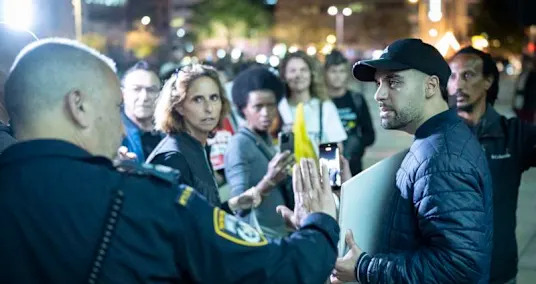
Israel Police arrested 21 anti-war protesters Saturday night as demonstrations against the conflict with Iran expanded in multiple cities despite restrictions on public gatherings.
Protests took place in Tel Aviv, Jerusalem, Haifa, and Beersheba, with hundreds of participants reported in Tel Aviv and Jerusalem and about 100 in Haifa, marking the largest turnout since weekly demonstrations began. Authorities said 13 people were arrested in Tel Aviv and eight in Haifa.
Police said the gatherings were not approved under Home Front Command regulations that ban events with more than 50 people. Officials said the increase in turnout followed calls by groups opposing the government to protest despite the restrictions.
“During a situation assessment that took place at the scene with a Home Front Command representative… it was clarified that there was a real risk to human life and accordingly, Yarkon [precinct] police commander Tzachi Sharabi ordered the gathering to be dispersed,” police said.
Hadash-Ta’al chairman Ayman Odeh, an Arab lawmaker involved in the protests, criticized the police response, calling officers fascists “in the service of the government” and saying they were afraid of “the heroic citizens who went out, despite everything, to make their voice heard.”

Survey shows broad, uneven support for war
The demonstrations come as a March 2026 survey by the Israel Democracy Institute found broad but uneven support among Jewish Israelis for Operation Roaring Lion. Support was strongest on the Right at 87% and about half on the Left.
The survey also found that Jewish and Arab respondents largely agreed that Iran’s resilience has been stronger than expected. Most Jewish respondents said Israeli society could sustain the campaign for up to one month, while 28% said as long as needed. Arab respondents were less optimistic about how long the public could endure the conflict.
A majority of Jewish respondents said Prime Minister Benjamin Netanyahu’s decision was driven by security considerations, while most Arab respondents viewed it as political.
LATEST POSTS
- 1
 Avoid Large Crowds In Bali & Swim At This Peaceful Waterfall With A Gorgeous, Natural Pool
 - 2Israel says it killed armed Hamas 'terrorists' in Gaza
- 3The Forgotten BMW Coupe That Turned a 5 Series Into Something Far More Exotic
- 4As cases of a rare, deadly infection rise, doctors worry fewer teens will get vaccinated
- 5Israeli lawmakers pass bill reviving death penalty for terrorists



- Red Crescent: More than 100,000 civilian structures damaged in Iran
- Well known SUVs With Low Energy Utilization In 2024 vote
- Kate Hudson, 46, says she doesn't need long workouts to feel good
- Metropolitan Greatness: The 6 Urban areas for Quality Living in 2024
- Research highlights potential dangers of ultra-processed foods for women under 50 regarding precancerous polyps
- Meet the Stars of the Feline World: Well known Pet Feline Varieties
- To fix a patient's irregular heartbeat, doctors first tested its digital 'twin'
- Misinterpretations and Mistakes Portrayed by Hollywood in the General set of laws
- Cells have more mini ‘organs’ than researchers thought − unbound by membranes, these rogue organelles challenge biology’s fundamentals