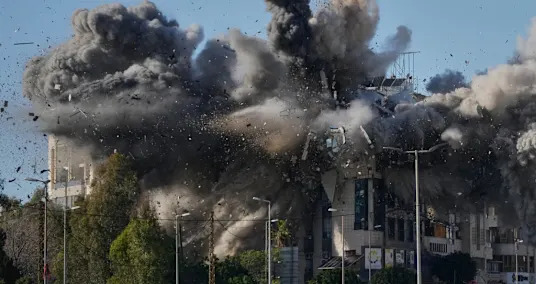
The US-Israel war on Iran and its ripple effect throughout the Middle East have had a devastating impact on Arab countries, with millions expected to slide into poverty, according to the United Nations.
A UN Development Programme (UNDP) report published on Tuesday said that gross domestic product (GDP) in the region was estimated to decline by approximately 3.7 to 6 percent after a month of war, equivalent to a contraction of $120bn to $194bn.
Abdallah Al Dardari, UN assistant secretary-general and director of the UNDP Regional Bureau for Arab States, said that 3.7 million jobs will be lost and about four million more people in the region could fall below the poverty line, noting that the war had highlighted the “fragility in the Arab economy”.
The report was based on projections of “a short but intense conflict lasting for four weeks”, signalling that the impact of the war, which has seen Iran attacking Gulf energy infrastructure and squeezing oil and gas exports through the Strait of Hormuz, will likely be even higher if it drags on longer.
Issued as tight oil supplies pushed Brent crude futures up 4.7 percent to more than $118 per barrel, the report said, “risks in strategic maritime corridors” had “knock‐on effects on inflation, trade flows, and global supply chains” that could undermine livelihoods in the Middle East’s “interconnected economies”.
It added that increases in poverty rates were “concentrated in the Levant and fragile countries (Sudan and Yemen), where baseline vulnerability is highest and shocks translate more strongly into welfare losses”.
The report noted that Lebanon, dragged into the war after Hezbollah struck Israel in retaliation for the US-Israeli killing of Iran’s Supreme Leader Ayatollah Ali Khamenei on February 28, is especially impacted, with “ongoing air strikes and evacuation orders … already causing widespread destruction of residential areas, transport infrastructure, and public services, alongside large‐scale displacement”.
“We hope the fighting will stop tomorrow, as every day of delay has negative repercussions on the global economy,” said Al Dardari.
LATEST POSTS
- 1
 Kenmore East reacts to their best overall delegation award at WNY Model United Nations General Assembly competition
 - 2Lawsuit claims ChatGPT exacerbated man's delusions leading to murder-suicide
- 35 Family SUVs for 2024: Which One Accommodates Your Family's Needs\uff1f
- 4I'm a woman who's into weightlifting. Was I man enough for the creatine-packed 'Man Cereal'?
- 5False fuel prices in fabricated graphics circulate in Malaysia as Iran war continues



- Israel explores creation of int'l force with Greece, Cyprus to deter Turkey
- Anti-war protests held across Israel under wartime gathering limits
- The Best Web-based Courses for Ability Advancement
- Meet the rescue team behind the astronauts as Artemis II's launch approaches
- Farewell, comet 3I/ATLAS! Interstellar visitor heads for the outer solar system after its closest approach to Earth
- Astonishing interstellar comet captured in new images by NASA Mars missions
- Manual for Notorious Fragrances: Immortal Aromas
- A Manual for Well known Western television Series
- Ethiopian earthquakes and volcanic eruptions: earth scientist explains the link