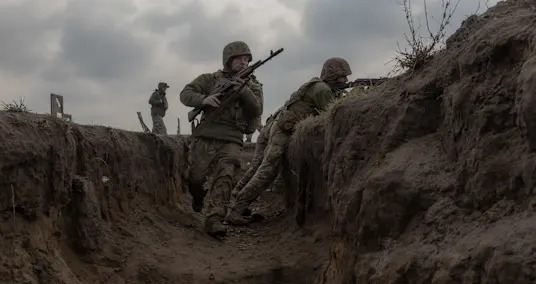
KYIV, Ukraine — Ukraine’s military leadership plans to phase out sending troops abroad for basic training, with a senior official saying much of what Western armies teach is “detached from our realities.”
The idea is to move all basic training fully onto Ukrainian soil, while keeping more specialized courses abroad, Yevhen Mezhivikin, deputy chief of the General Staff’s Main Directorate of Doctrine and Training, told Militarnyi last week.
NATO’s Supreme Allied Commander Transformation, Adm. Pierre Vandier, explained the logic during his first visit to Ukraine last weekend, calling Ukraine’s warfighting adaptation “one of the strongest lessons” for the alliance back in February and acknowledging that Russia is outpacing NATO in absorbing those same lessons, per Ukrinform.
“Russia is very good at adapting, really, better than we are today,” Vandier said. “So we need to put oil in all the gears.”
The role reversal is already in motion.
Despite Russia launching a massive spring offensive this week, Ukraine has clawed back more territory in its counteroffensive than at any point since 2023. It’s also knocked out an estimated 40% of Russia’s oil export capacity with long-range strikes on its export terminals — and still had enough experts and drones to send 228 drone specialists to the Middle East to help allies intercept Iranian Shaheds that have attacked over a dozen countries.
In an interview last month, Deputy Minister of Defense Lt. Col. Yurii Myronenko, who was appointed on Wednesday as the Defense Ministry’s inspector general and who previously led the team behind the DELTA battlefield situational-awareness system, had already seen what was coming.
Ukraine needs “powerful partners” in NATO, he said, but it also has something to trade back, including “technological exchanges,” and the ability to make decisions “very close to the front line.”
Allied governments have been pushing for this reversal, too.
Britain was “the first country to propose moving all training to Ukraine and concentrating efforts on specific centers,” Mezhivikin had said.
This month, Kyiv sent a cadre of military advisers to Germany to teach drone warfare, counter-UAS tactics and electronic warfare integration — subjects NATO armies have studied in doctrine but never tested under persistent combat conditions. Germany is the first NATO member to formally invite Ukrainian trainers into its own army’s schools.
“We have high expectations,” Lt. Gen. Christian Freuding, head of the German army, told Reuters. “The Ukrainian military is currently the only one in the world with frontline experience against Russia.”
Overseas training “has not been cancelled,” military spokesperson Dmytro Lykhovii clarified three days after the original statement. It is simply scaling down, he said, according to Ukrainska Pravda.
Courses abroad will be “clustered and optimized,” Lykhovii said, with a short list of partner nations specializing in specific lanes. Weapons and equipment courses, commander-leader education and senior NCO training all continue outside Ukraine.
But the volume of troops sent abroad for basic training has “noticeably decreased over the past two years,” Lykhovii told RBC-Ukraine.
Basic training will continue to run in three EU countries with support from four NATO states through 2026, he said — down from the 18 EU member states that hosted Ukrainian brigade-level training of all types through late 2025, per RBC-Ukraine.
The shift has been twelve years in the making. Ukraine is now the one doing the teaching, exporting hard-won expertise in drone warfare, counter-UAS and electronic warfare to allied armies that have studied these subjects in doctrine but never tested them under fire.
Ukraine’s DELTA system — the battlefield operating picture its units use to fuse feeds, track activity and pass targeting data — has entered NATO’s own training exercises.
The Defense Ministry said DELTA served as the primary command platform for the Ukrainian “red team” during NATO’s REPMUS 2025 unmanned-systems exercise in Portugal, where the team won all five scenarios, coordinating more than 100 drones across maritime, air, ground and underwater domains, and simulating the destruction of a NATO frigate whose detection systems failed to spot the incoming Magura V7 naval drones in time.
And in Estonia, a small Ukrainian drone team playing opposing force during Exercise Hedgehog 2025 used drones and rapid-targeting analysis to render a mechanized NATO unit combat-ineffective in half a day, destroying 17 armored vehicles and roughly 30 additional targets, according to The Wall Street Journal.
The timeline for training across allied forces is tight. Western intelligence assessments put a possible large-scale Russian offensive against NATO as early as 2029.
“That’s almost the day after tomorrow,” he told Reuters. “We have no time — the enemy doesn’t wait for us to declare we’re ready.”
That’s why Ukraine keeps pushing the alliance forward and offering up its experience to help, officials say.
“Having very powerful partners from NATO countries,” Myronenko said, “we will all have a very good chance to always be ahead of the Russians.
LATEST POSTS
- 1
 Vote In favor of Your Favored Pizza Cover
 - 2Private sector revives the climate disaster database Trump tried to squash
- 3Prehistoric wolf’s gut frozen in time reveals an ice age giant
- 4Indian rocket launches record-breaking BlueBird 6 smartphone satellite to orbit (video)
- 5Judge approves Purdue Pharma’s new $7B opioid settlement with the Sacklers


- Where You Could Sleep With Snorlax in Japan, From MIMARU’s Pokémon Rooms to Grand Hyatt Tokyo’s Limited Pokémon Suite
- Study reveals links between global food systems, obesity, and climate change
- IVE 2026 'Show What I Am' Tour: How to get tickets, prices, dates and more
- How to get tickets for AC/DC's 2026 'Power Up' Tour
- Nigeria’s return to Windsor castle signals new era in UK economic partnership
- Image of foreigners being arrested in S.Africa during Eid is AI-generated
- Fact Check: Some Bridge Photos Circulating Do NOT Show The Hongqi Bridge That Collapsed In Southwest China Nov. 11, 2025
- Watch Blue Origin's huge New Glenn rocket ace its epic landing on a ship at sea (video)
- The Green Transformation: 5 Feasible Living Practices